Showing posts with label Cisco. Show all posts

Monday, December 14, 2015

Notes on FabricPath

FabricPath facts

Creator of STP, Radia Perlman, developed TRILL – Transparent Interconnect of Lots of Link to overcome the limitations of STP. Cisco enhanced the protocol and named it FabricPath.

http://www.cisco.com/c/dam/en/us/products/collateral/interfaces-modules/mds-9000-10-gbps-8-port-fcoe-module/white_paper_c11-644818.doc/_jcr_content/renditions/white_paper_c11-644818-2.jpg
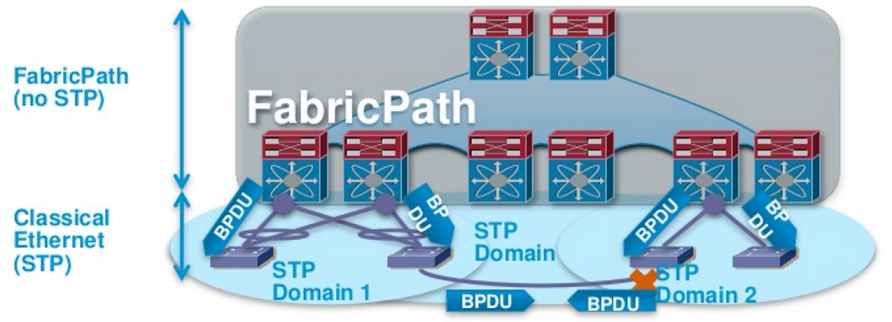
Limitation of STP – As the figure above clearly shows that STP allows only a single path to destination in a L2 domain and blocks the redundant path. Whereas Fabricpath enables all path, scalable upto 16 ECMP, which ensures the utilization of full available bandwidth.
Difference with vPC -  vPC addresses the blocked link limitation, but is only scalable to two spine or core switch and still relies on STP for loop prevention. vPC+, an enhanced version of vPC can be used in conjunction with fabricpath.
A single switch – A cloud of fabricpath capable switches can also be connected to a traditional STP network, where the cloud is considered as one single switch. Ideally, the fabricpath cloud is configured as root bridge in the STP domain.
C:\Users\Dell01\Desktop\fabricpath.png

Link state protocol – Layer 3 routing intelligence brought to Layer 2. FabricPath uses ISIS routing protocol with FabricPath-specific extensions, like exchanging switch ID (SID) to determine reachability and path selection in the FabricPath domain.
Conversational learning of mac address – In a classical switched network all switches maintains table all MAC address of hosts in the network. This table, TCAM can grow larger as hosts increases. Fabricpath switch learns remote MAC addresses only if the remote device is having a bidirectional conversation with a locally connected device.

Wednesday, July 30, 2014

MPLS L3 VPN - Part 1

MPLS Core setup


·         LDP and IGP in core

P routers

Enable LDP
mpls label protocol ldp
interface Fastethernet x/x             
(x/x = all interface)
              mpls ip

Enable core IGP
router ospf  1
     network 0.0.0.0 255.255.255.255 area 0

PE routers
Enable LDP
mpls label protocol ldp
interface Fastethernet x/x
  (x/x = loopback + all int facing P, not facing CE)
         mpls ip

Enable core IGP
router ospf  1
     network x.x.x.x 0.0.0.255 area 0
(x.x.x.x = interface facing P, not facing CE)


·         VPNv4 between PEs

PE routers

Enable MP-BGP VPNv4
router bgp 100
      no bgp default ipv4-unicast
      neighbor x.x.x.x remote-as 100
      neighbor x.x.x.x update-source loopback1
      address-family vpnv4 unicast
              neighbor x.x.x.x activate
              neighbor x.x.x.x send-community extended


·         VRF Configuration

PE routers

Create VRF
ip vrf AAA  (only for ipv4)
“or”  vrf definition AAA    (for both ipv4+ipv6)

    rd 100:1
    route-target export 100:1
    route-target  import 100:1


Assign interface to VRF
Interface Fa x/x            (interface facing CE)
    ip vrf forwarding AAA
    ip address …